Study Models Uranus and Neptune's Unusual Magnetic Fields
Computer simulations paired with Voyager 2 measurements suggest that changing conductivity deep inside the ice giants may shape their tilted magnetic fields.
FlyMarshall Newsroom1 min read
Photo: Robert Lea
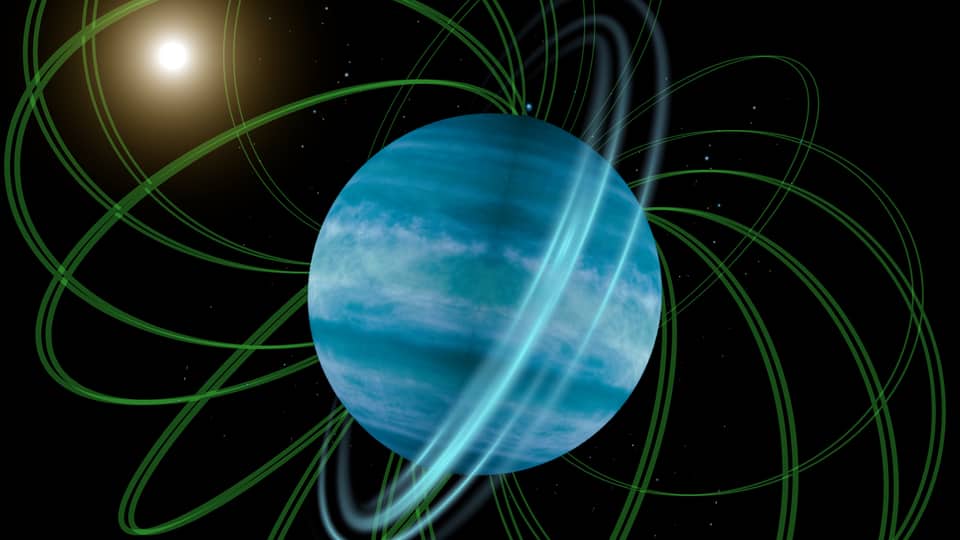
A study led by Chi Yan of the University of Texas at Austin used computer simulations and Voyager 2 measurements to model the magnetic fields of Uranus and Neptune. The researchers propose that electrical conductivity rising with depth may help explain why the planets’ magnetic-field axes sit at unusual angles to their rotation axes.
Key details
- Voyager 2 measured Uranus’s magnetic-field axis at a tilt of about 59 degrees relative to its rotation axis.
- Voyager 2 measured Neptune’s magnetic-field axis at a tilt of about 47 degrees relative to its rotation axis.
- At the ice giants’ extreme interior pressures and temperatures, water may separate into ions, increasing the electrical conductivity of deeper material and affecting the magnetic dynamo process.
- The simulations suggest that magnetic-field configurations may shift by tens of degrees over decades, while other modeled periods show smaller changes.
- Researchers are analyzing infrared aurora observations from the James Webb Space Telescope alongside Voyager 2 data and simulations.
Voyager 2 measured Uranus’s magnetic-field axis at about 59 degrees from its rotation axis.
Why it matters
A planet’s magnetic field reflects processes inside it, so changes in field shape can help researchers investigate the conditions deep below the atmosphere. Comparing aurora observations with spacecraft measurements and simulations gives researchers another way to study those changes.
More stories
Caltech-Led ASTRA Robot Builds Part of an Antenna Structure in Orbit
NASA's Curiosity Rover Images Planned Drill Target Nazca
Rocket Lab Neutron Launch Price Reportedly Rises to $70 Million

2027 and 2028 Solar Eclipses Offer Viewing Routes Across Three Continents
NASA's ESCAPADE Probes Complete Powered Earth Flybys