Satellite and Ground Sensors Track Fireballs Over Three Continents
Observations of fireballs over the South Atlantic, Alaska and Australia show how satellites and ground instruments can help reconstruct atmospheric entries.
FlyMarshall Newsroom2 min read
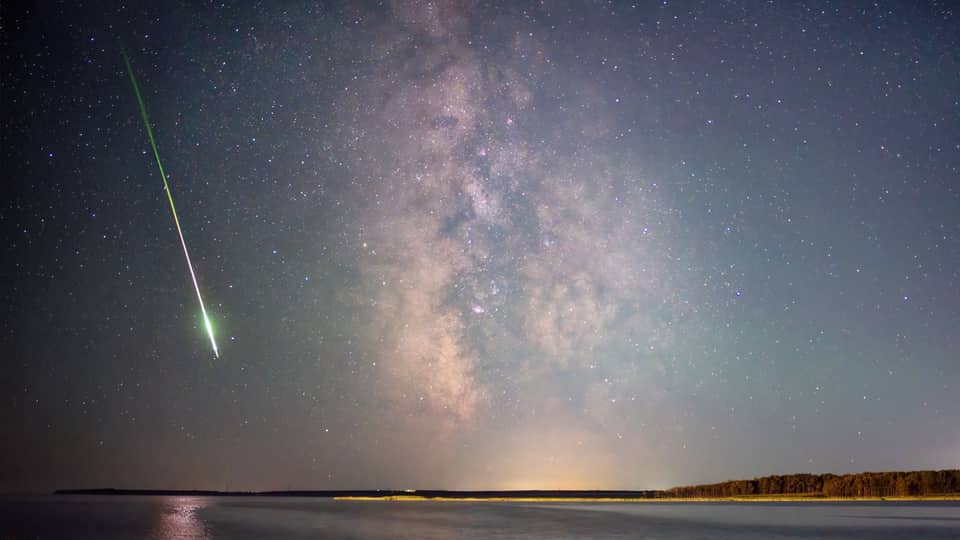
Photo: Chi Shiyong/VCG via Getty Images
Researchers have used satellite detections, seismic and infrasound readings, radar and video to study fireballs over the South Atlantic, Alaska and northwest Queensland. The observations captured different parts of each event, from the glowing path through the atmosphere to shock waves and material moving through the air.
Key details
- A bolide over the South Atlantic near Argentina on April 1, 2026, appeared in detections from U.S. space-based sensors, NOAA’s GOES-East satellite and Europe’s Meteosat Third Generation Imager-1. Its peak brightness occurred at about 90.5 kilometers altitude.
- Researchers reconstructed a fireball over south-central Alaska on April 24, 2025, using 37 seismic stations, 16 infrasound sensors, four infrasound arrays, weather radar and optical video.
- A fireball crossed northwest Queensland, Australia, on May 20, 2023. Researchers estimated that the roughly 3.7-meter object released about 7.1 kilotons of energy.
- Researchers reported that seismic and infrasound measurements can help constrain shock waves, trajectory, fragmentation and energy. Optical observations record the luminous path, while weather radar can detect material that survives and slows in the atmosphere.
Researchers estimated the energy of the May 2023 Queensland fireball at about 7.1 kilotons.
Why it matters
For aviation and space-monitoring teams, combining satellite observations with ground measurements gives researchers more ways to reconstruct an object’s path and behavior in the atmosphere. Those records can help refine models used to assess future atmospheric entries.
What happens next
Researchers can continue testing entry models against observations from satellites, radar, cameras and ground sensors. Which combination of instruments do you think will add the most detail to the next fireball reconstruction?
More stories
November 2026 Skywatching: Venus, Mercury and Planet Pairings

Nine Fictional Spacecraft That Make Unsettling Journeys
SpaceX Reportedly Limits Falcon 9 Commercial Bookings Beyond 2028
Rocket Lab Targets November 3 for Electron's 99th Mission
This Week In Space Episode 234 Explores Lunar Caves