Moon, Mars and Jupiter Set for November Skywatching Display
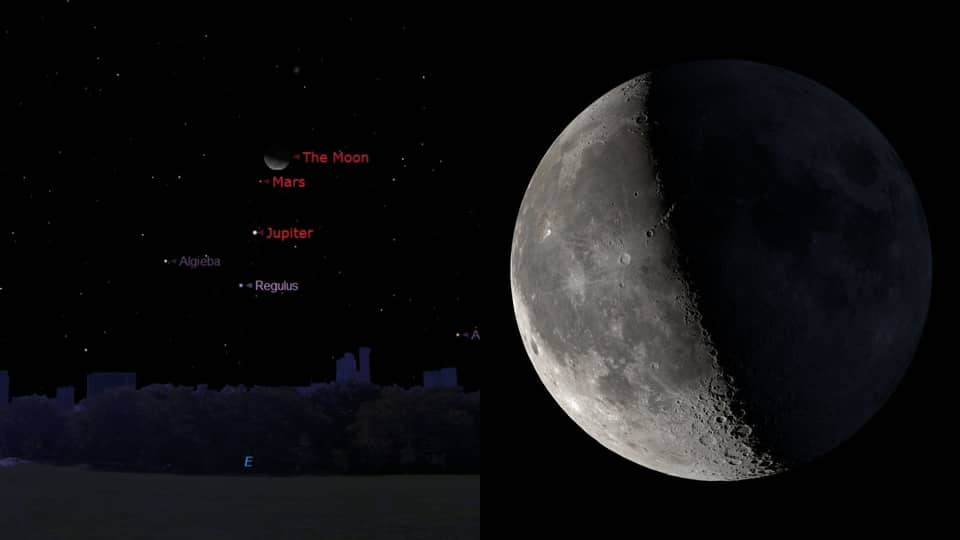
The waning Moon is forecast to appear near Mars, Jupiter and Regulus in the eastern sky overnight November 1–2, 2026.
FlyMarshall Newsroom2 min read
Photo: Right: NASA Scientific Visualization Studio. Left: Starry Night Pro 8
Skywatchers may see the waning Moon, Mars, Jupiter and Regulus together in the eastern sky overnight November 1–2, according to the forecast. At about an hour after midnight, the Moon is expected to be roughly 45% illuminated and less than 5 degrees from Mars.
Key details
- Jupiter is forecast to appear below Mars, with Regulus farther along the apparent line toward the horizon.
- The Beehive Cluster, or M44, is expected about 10 degrees from the Moon’s unilluminated side.
- A lunar occultation of Jupiter is forecast to begin at 20:45 GMT on November 2. Visibility will depend on location, with parts of Australia, Indonesia and other island locations in view.
- For US observers, the Moon is forecast to appear about 1 degree from Regulus at moonrise on November 3.
- A lunar occultation of Regulus is forecast for November 3 in parts of South America, including Brazil, Argentina, Chile and Colombia.
The Moon is forecast to appear less than 5 degrees from Mars about an hour after midnight.
Why it matters
The forecast gives observers in different regions several opportunities to track close pairings involving the Moon and bright objects in the sky. The Jupiter and Regulus occultations offer views that depend on location, while US observers can look for the Moon near Regulus at moonrise.
What happens next
The sequence of close sky pairings continues through November 3, giving observers several nights to watch the Moon move past bright planets and stars. Which pairing will you look for first?
More stories

November 2026 Skywatching: Venus, Mercury and Planet Pairings

SpaceX Reportedly Limits Falcon 9 Commercial Bookings Beyond 2028

Rocket Lab Targets November 3 for Electron's 99th Mission

This Week In Space Episode 234 Explores Lunar Caves
Asteroid 2015 TB145 Passed Earth About 300,000 Miles Away in 2015