Cape Cod Bay Meteorite Traced to an Orbit Near Jupiter
Researchers reconstructed the path of a May 30, 2026, daytime bolide over coastal Massachusetts and traced its elongated orbit nearly to Jupiter.
FlyMarshall Newsroom1 min read
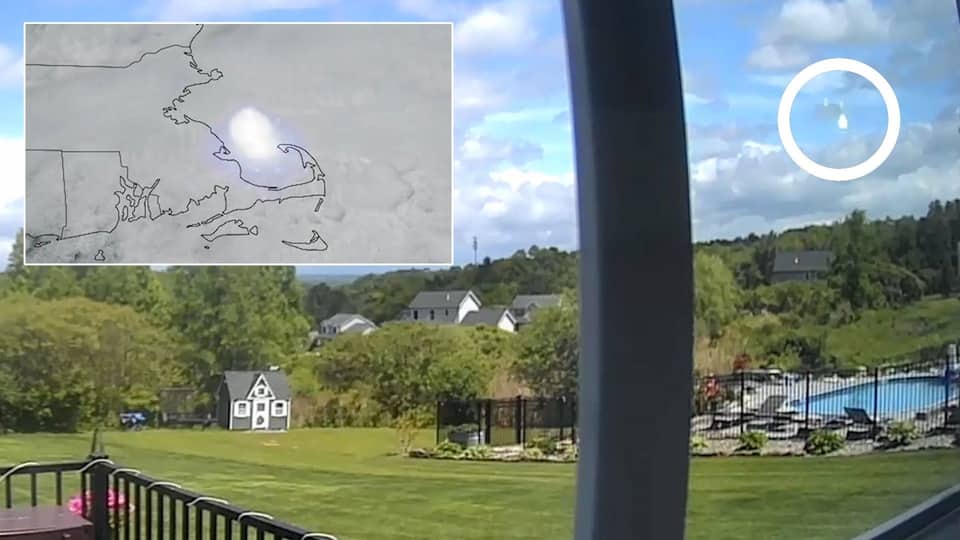
Photo: CIRA/NOAA/R. Schott/American Meteor Society
A bright bolide crossed the sky over coastal Massachusetts at about 1:06 p.m. local time on May 30, 2026. Researchers analyzed radar, infrasound measurements and camera footage to reconstruct its orbit after the object broke apart and debris fell into Cape Cod Bay.
Key details
- The study used meteor radar from SIMONe, weather radar from NEXRAD, infrasound measurements and camera footage.
- Researchers estimated that the meteoroid fragmented at an altitude of about 32 kilometers.
- They estimated the breakup energy at roughly 500 tons of TNT and the total impact energy at about 1.1 kilotons of TNT.
- The analysis found no identified link to a known meteor shower.
- The reconstructed orbit extended nearly as far as Jupiter. The researchers proposed, but did not establish, that Jupiter’s gravity may have influenced the object’s path.
- The researchers interpreted the orbit as consistent with an origin in the main asteroid belt; the object’s precise history remains uncertain.
- The research was described as an arXiv preprint.
Researchers estimated that the meteoroid measured about one meter across.
Why it matters
Combining meteor radar, weather radar, infrasound and camera records gave researchers several independent kinds of measurements to use in reconstructing the object’s path. That approach can connect a meteor’s passage through Earth’s atmosphere with the orbit it followed before arrival.
More stories

Saturn V Rocket Makes Its First Flight on Apollo 4

Jupiter and Mars to Appear Close in November 2026 Sky

Researchers Model Primordial Black Hole Origin for JWST Little Red Dot

Starfish Space Says Otter 24C Cannot Be Recovered After Communications Loss

France Awards Airbus and Thales Contract for Two IRIS Military Satellites