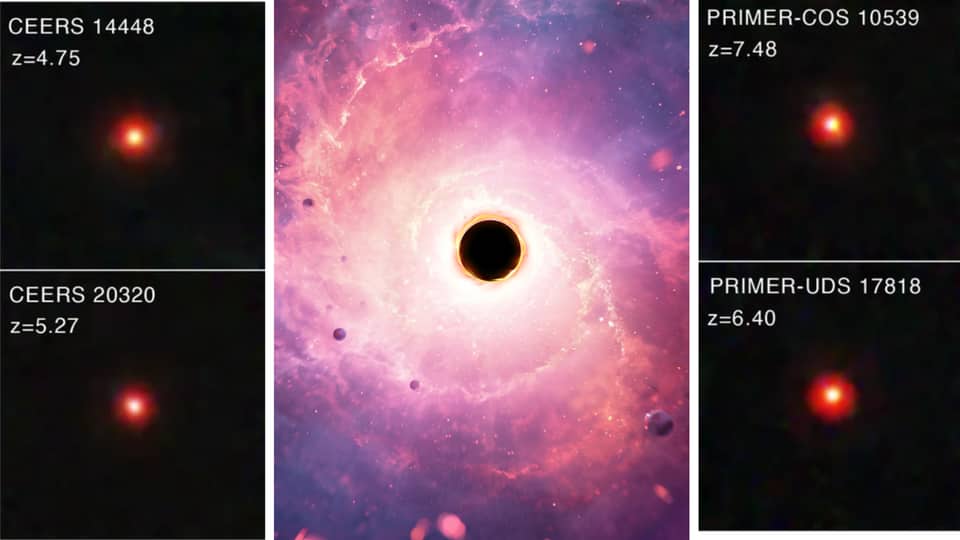
Researchers Model Primordial Black Hole Origin for JWST Little Red Dot
A study modeled whether the distant object QSO1 could have formed around a primordial black hole, with researchers planning to examine about 100 more Little Red Dots.
FlyMarshall Newsroom1 min read
Photo: Robert Lea/NASA, ESA, CSA, STScI, Dale Kocevski (Colby College))
Researchers modeled three possible formation scenarios for Little Red Dot QSO1, including one in which a small primordial black hole accretes surrounding gas. They judged that scenario the most likely of the three, but the study does not establish that QSO1 or Little Red Dots generally are primordial black holes.
Key details
- QSO1 lies about 13.1 billion light-years from Earth and was observed roughly 700 million years after the Big Bang.
- The object is described as consisting almost entirely of hydrogen and helium.
- The research appeared in Physical Review Letters in June.
- Researchers plan to assess about 100 additional Little Red Dots observed by the James Webb Space Telescope for possible primordial-black-hole origins.
QSO1 was observed about 700 million years after the Big Bang.
Why it matters
The researchers’ work compares possible explanations for an object from the early universe using formation models. Examining more Little Red Dots could show whether the proposed primordial-black-hole scenario applies beyond QSO1.
More stories
NASA's ESCAPADE Probes Complete Powered Earth Flybys
Saturn V Rocket Makes Its First Flight on Apollo 4

RFA One Launch from Scotland's SaxaVord Spaceport Moves to 2027

American Airlines Reopens Flagship Dining at Los Angeles International Airport
France Awards Airbus and Thales Contract for Two IRIS Military Satellites