
CAS Space Kinetica-2 Second Flight Puts 18 Qianfan Satellites in Orbit
CAS Space said its Kinetica-2 Y2 liquid-propellant rocket lifted off at 8:15 a.m. on Tuesday, November 3, 2026, from the Dongfeng Commercial Space Innovation Experimental Zone and delivered 18 Qianfan polar-orbit satellites to their planned orbits. The flight was the rocket's second mission and its first large satellite-internet deployment.
FlyMarshall Newsroom2 min read
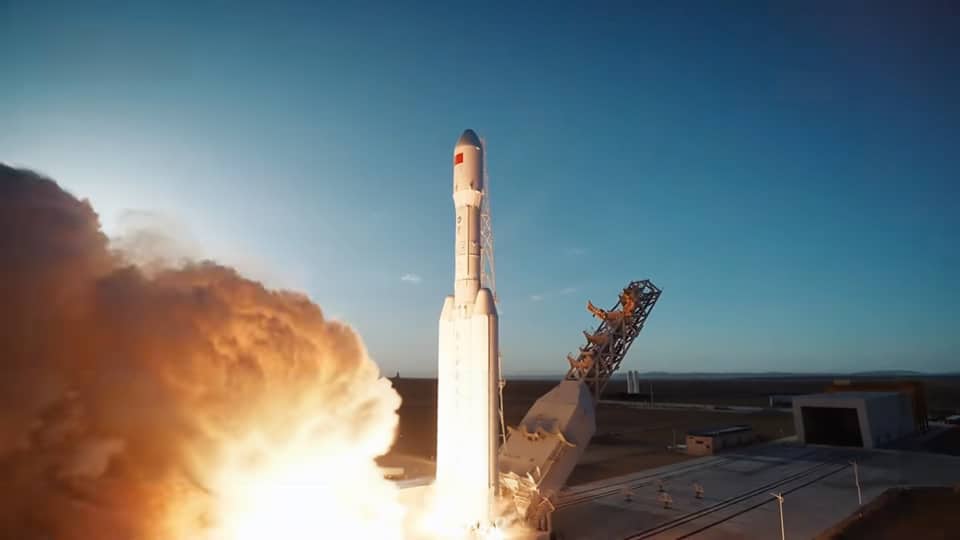
Representative image of a CAS Space Kinetica-2 / Lijian-2 launch. Photo: China News Service / Wikimedia Commons, CC BY 4.0
CAS Space said Kinetica-2 Y2 lifted off at 8:15 a.m. China Standard Time on Tuesday, November 3, 2026, from Launch Area 140 at the Jiuquan Satellite Launch Center, in the Dongfeng Commercial Space Innovation Experimental Zone, and placed 18 Qianfan polar-orbit satellites in their planned orbits. CAS Space said the payload was the 21st batch in the Qianfan polar-orbit constellation. The satellites were built by the Innovation Academy for Microsatellites of the Chinese Academy of Sciences.
The flight was the second for Kinetica-2 after a March debut that carried the prototype Qingzhou cargo spacecraft, and the first Kinetica-2 mission dedicated to a large satellite-internet deployment. Yang Haoliang, chief designer and commander-in-chief of the Kinetica-2 program, said China's low-orbit satellite internet is in a period of intensive deployment.
Key details
- Vehicle: Kinetica-2, liquid-propellant, universal booster core. CAS Space cites eight tons to a 500-kilometer sun-synchronous orbit and 12 tons to a 200-kilometer low-Earth orbit.
- Kinetica family: 18th launch. CAS Space said the series has delivered one spacecraft and 139 satellites, more than 27 tons of payload. Kinetica-2 has placed more than nine tons on its first two flights.
- Shanghai municipal government, October 28: Qianfan had launched 256 low-Earth orbit broadband satellites, with plans to add 68 and reach 324 by the end of 2026.
Yang Haoliang, Kinetica-2 chief designer and commander-in-chief, said high-frequency, highly reliable, and low-cost launch capacity is essential to satellite internet infrastructure.
More stories

NASA Announces X-70 Fractal Experimental Aircraft
Super Strypi's 2015 Debut Launch Attempt Ended Before Reaching Orbit
NASA Swift Observatory Re-enters Over Western Indonesia
Artemis II Launch Linked to Ionospheric Changes in GPS Study

Air Tahiti Nui Signs With SpaceX to Put Free Starlink on Its 787-9 Fleet
