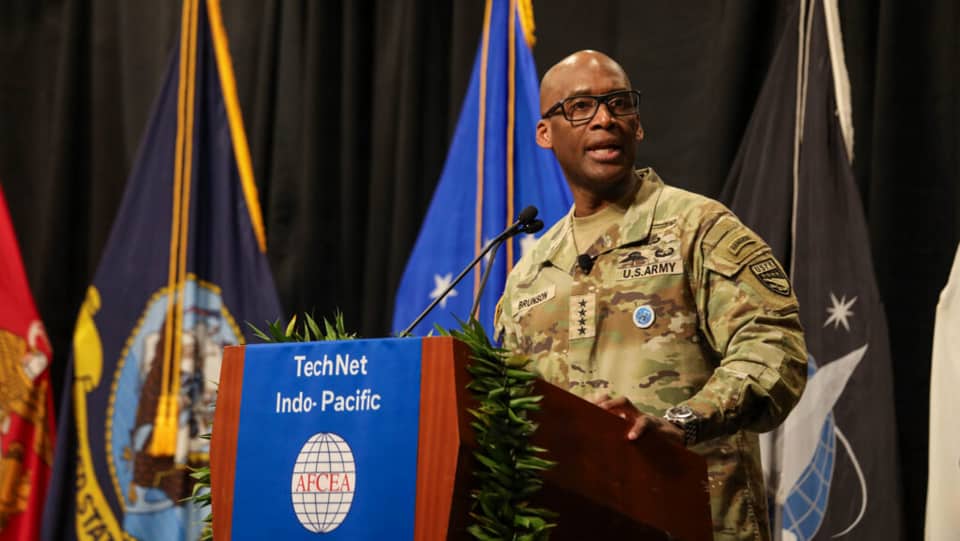
USFK Commander Calls for Resilient, Coalition-Ready Military Systems
At AFCEA TechNet Indo-Pacific 2026 in Honolulu, Xavier T. Brunson urged industry to build systems that can operate through disrupted communications and work across partner forces.
FlyMarshall Newsroom2 min read
Photo: Breaking Defense
Xavier T. Brunson, commander of United Nations Command, Combined Forces Command, and United States Forces Korea, called on industry to develop resilient military systems during his October 27 address at AFCEA TechNet Indo-Pacific 2026 in Honolulu. Brunson described electronic interference affecting U.S. and allied systems on the Korean Peninsula and urged companies to build capabilities that can function when communications are disrupted.
Key details
- Brunson cited GPS interference in the West Sea and attempts to disrupt servers, sensors, and networks.
- He described USFK’s use of high-frequency networks, proliferated low-Earth-orbit satellite communications, and terrestrial mesh networks to maintain command and control if primary links fail.
- He urged companies to design for coalition use, with open interfaces and data-protection approaches that do not rely only on network boundaries.
- Brunson cited the Army publication “How the Army Fights” as guidance industry can consult when aligning products with military requirements.
Brunson said USFK uses high-frequency networks, proliferated low-Earth-orbit satellite communications, and terrestrial mesh networks to maintain command and control if primary links fail.
Why it matters
For US aviation and aerospace companies developing communications, sensors, and networked systems, Brunson’s remarks point to a clear operational requirement: systems must keep working when links face interference and must exchange information with partner forces. He called for coalition targeting information to move rapidly, using a hypothetical Korean radar tracking an incoming missile to illustrate verification and transfer to a coalition fires network in milliseconds.
What happens next
Brunson’s call gives defense and aerospace suppliers a practical focus for future system design: resilient links, open interfaces, and coalition interoperability. Which technologies will best keep partner forces connected when communications are disrupted?
More stories

Ballistic missile reported to have fallen at Aden International Airport

Bombardier and BAE Systems Sign MoU on Potential Combat-Air Cooperation

UK Sets 2030 Defense Spending Target, Plans Drone Testing Unit
General Atomics President Discusses European Unmanned Aircraft Strategy
Navy Leaders Warn of Years-Long Ship Maintenance Demand