
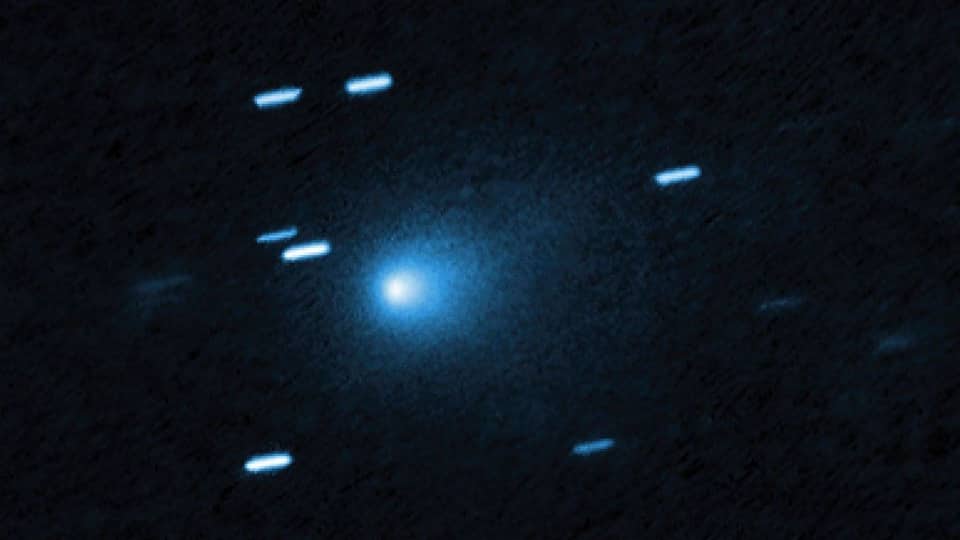
Webb Observations Reveal Unusual Ice-Grain Pattern in Interstellar Comet 3I/ATLAS
Three James Webb Space Telescope observations recorded a distinctive infrared spectrum from interstellar comet 3I/ATLAS between August 2025 and April 2026.
FlyMarshall Newsroom1 min read
Photo: NASA, ESA, David Jewitt (UCLA); Image Processing: Joseph DePasquale (STScI)
The James Webb Space Telescope observed 3I/ATLAS with its NIRSpec instrument on three occasions spanning August 2025 to April 2026, before and after the comet’s closest approach to the Sun. The reported spectra showed a strong absorption feature near 3 microns, while features near 1.5 and 2 microns appeared weak or absent.
Key details
- Researchers modeled the spectrum as evidence that the comet released water-ice grains smaller than a micron, mixed with substantial dust.
- The reported ice spectrum resembles that of some carbon-dioxide-rich trans-Neptunian objects, which orbit beyond Neptune.
- A separate 2025 JWST study reported a carbon-dioxide abundance among the highest observed in a comet.
- The study was reported as published in The Astrophysical Journal Letters on October 26, 2026.
The reported spectrum showed strong absorption near 3 microns, with weak or absent features near 1.5 and 2 microns.
Why it matters
The spectrum gives researchers a way to compare the icy material in an interstellar comet with distant icy bodies in our solar system. The researchers interpret the resemblance as a possible link to trans-Neptunian-object-like material, while the observations do not establish where 3I/ATLAS formed.
More stories

Expedition 1 Began the ISS's Continuous Human Presence 26 Years Ago

HiRISE Image Reveals Colorful Rocks in Mars' Southern Highlands

SpaceX's Starshield Program Targets Government Satellite Communications

Ryanair CEO Forecasts European Fares Could Rise 10% to 20%

Adrian Hamilton-Manns Named PIA Chief Executive
