
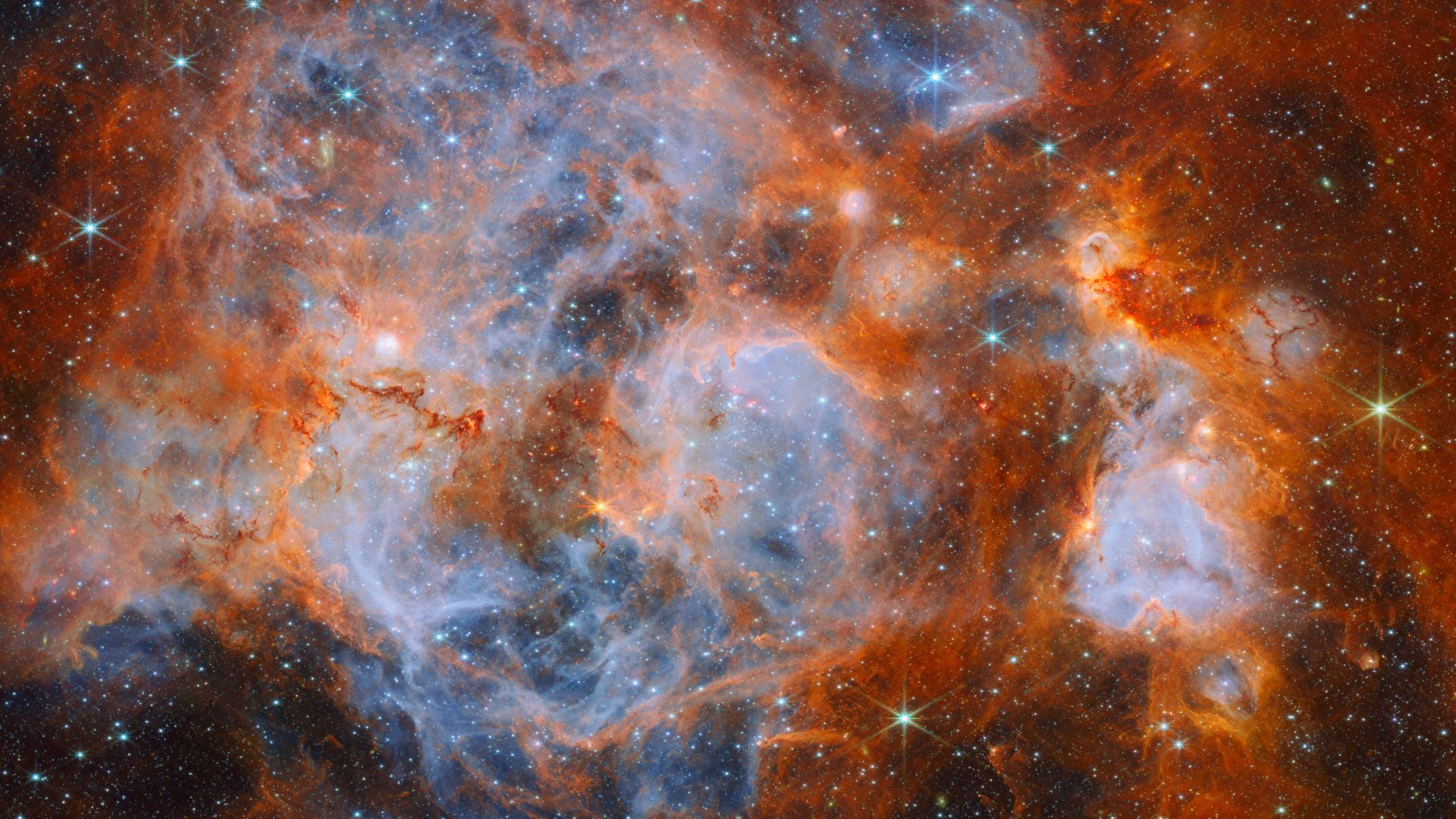
Webb Image Reveals Star Formation in N159
A James Webb Space Telescope view shows N159, a star-forming region in the Large Magellanic Cloud about 161,000 light-years from Earth.
FlyMarshall Newsroom1 min read
Photo: ESA/Webb, NASA & CSA, E. Sabbi, M. Zamani (ESA/Webb)Acknowledgement: M. H. Özsaraç
A James Webb Space Telescope image features N159, a star-forming region in the Large Magellanic Cloud, a satellite galaxy of the Milky Way.
Key details
- N159 spans about 230 light-years and is estimated to be less than 3 million years old.
- The region contains ionized hydrogen and molecular hydrogen.
- Radiation from nearby stars ionizes hydrogen, while stellar winds have shaped the region.
- N159 has lower metallicity than star-forming regions in the Milky Way.
N159 spans about 230 light-years in the Large Magellanic Cloud.
Why it matters
Webb observations of N159 can help astronomers compare stars at different stages of development, including pre-main-sequence stars that still gather material.
What happens next
Further study of N159 can help astronomers examine how stars form in a neighboring galaxy. Which Webb images would you like to see explored next?
More stories
Rubin Observatory Could Find More of Earth's Mini-Moons
Hunter's Moon Photos Include Passenger Jet Over San Francisco
NASA Outlines Competition Model 2.0 for Science Missions

NASA Revises Artemis Landing Plans for 2027 and 2028 Missions

Blue Origin Rebuilds New Glenn Launch Pad for Targeted 2026 Return
