JWST Data Reveals 51 Eridani b With New Image-Processing Method
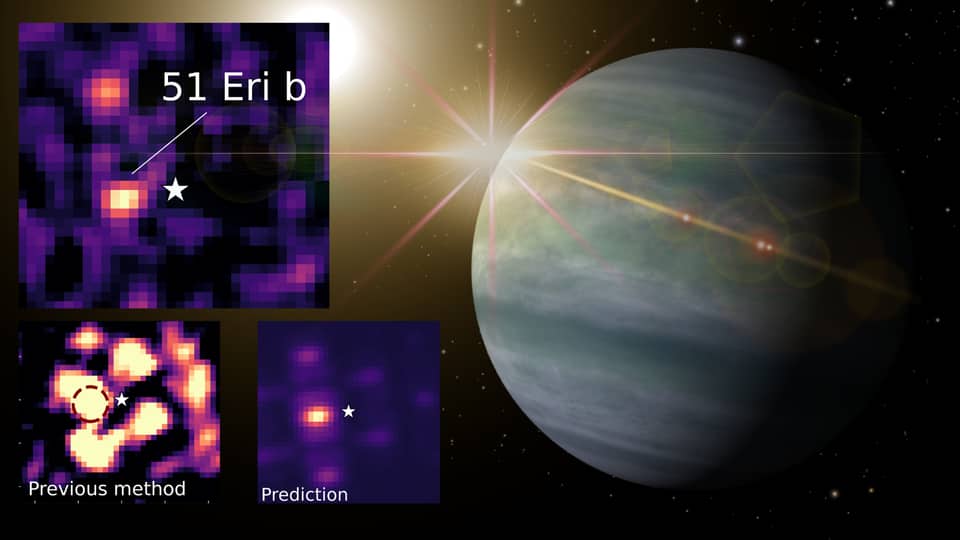
Researchers used Physics-based Learning for Imaging Planets to recover a signal from the exoplanet in James Webb Space Telescope observations.
FlyMarshall Newsroom1 min read
Photo: Robert Lea/Rodrigo Ferrer-Chavez.
Researchers applied Physics-based Learning for Imaging Planets (FLIP) to James Webb Space Telescope observations and recovered a signal from 51 Eridani b that conventional processing had not revealed. The team used a telescope simulation calibrated against observed data to model and subtract glare from the planet’s host star.
Key details
- 51 Eridani b is a gas giant with about 11 times Jupiter’s mass, orbiting a star roughly 97 light-years from Earth.
- Researchers tested FLIP on JWST observations of three systems: HIP 65426 and 51 Eridani, which have known exoplanets, and TYC 5899, with no known planets.
- The analysis used JWST observations collected about two years before the research was published.
- The research appeared in Nature on Nov. 4, 2026.
The team reported that FLIP improved faint-exoplanet detection performance by 2 to 15 times in its tests.
Why it matters
A host star’s glare can obscure the much fainter light from an orbiting planet. FLIP’s approach uses a calibrated telescope model to separate that glare from the planet’s signal, giving researchers another way to examine faint exoplanets in telescope data.
More stories

AST SpaceMobile Plans Blacklift Rocket for BlueBird Satellites
ESA Releases Hera Image of the Didymos Asteroid System

Aurora Forecast Puts Northern Lights in View Across Parts of the U.S.

NASA Schedules First Air Show at Kennedy Space Center for November 2026

IndiGo in Talks to Buy 100 Embraer Regional Jets, Sources Say