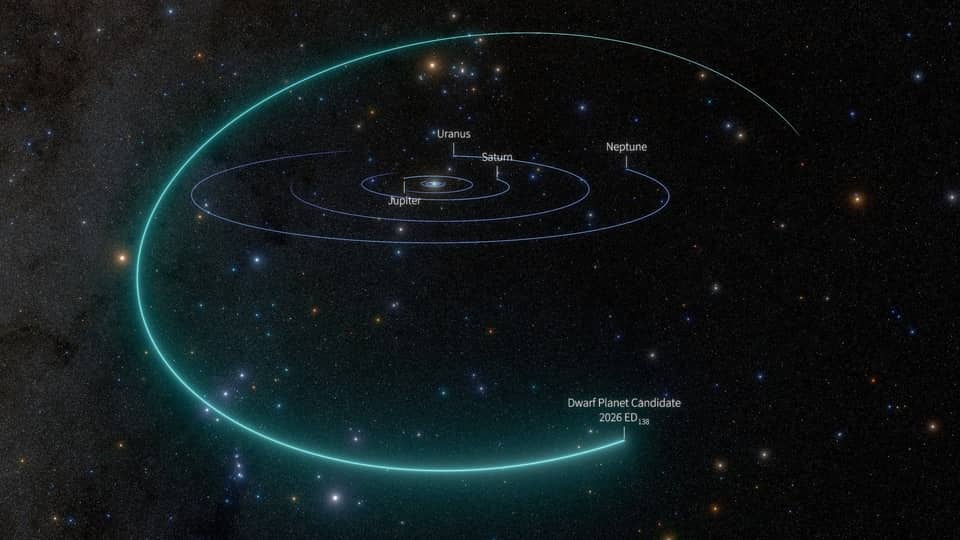
Rubin Observatory Data Reveals Distant Object 2026 ED138
Matthew Holman identified trans-Neptunian object 2026 ED138 in previously collected Rubin Observatory observations, with records spanning multiple nights in 2026.
FlyMarshall Newsroom1 min read
Photo: NSF–DOE Vera C. Rubin Observatory/NOIRLab/SLAC/AURA/R. ProctorImage Processing: M. Zamani (NSF NOIRLab)Orbit data provided by the IAU Minor Planet Center (MPCorb catalog), funded by NASA PDCO and the Tamkin Foundation.Star map: NASA/Goddard Space Flight Center Scientific Visualization Studio. Gaia DR2: ESA/Gaia/DPAC
Astronomer Matthew Holman identified 2026 ED138 while analyzing previously collected data from the Vera C. Rubin Observatory. The observations revealed a trans-Neptunian object beyond Neptune; its classification as a dwarf planet remains unconfirmed.
Key details
- Rubin Observatory recorded the object 30 times on 20 nights between March 4 and July 11, 2026.
- Archived Dark Energy Camera observations from Cerro Tololo Inter-American Observatory reportedly extend back to 2016.
- The object's reported orbit sits about 46 astronomical units from the Sun and tilts about 25 degrees relative to the solar system's plane.
- An initial diameter estimate ranges from 600 to 1,500 kilometers. Researchers need infrared observations to refine its size.
- Holman and Kevin Napier developed the search program used to identify the object.
Rubin Observatory recorded 2026 ED138 30 times on 20 nights from March 4 through July 11, 2026.
Why it matters
Repeated observations from Rubin and archival telescope data give astronomers a longer record for studying a distant object's orbit and physical properties. Measurements of its size will help researchers assess whether 2026 ED138 qualifies as a dwarf planet.
What happens next
Further measurements, including infrared observations, can help establish the object's size and clarify its classification. What might astronomers learn from the next observations of 2026 ED138?
More stories

NASA Terra Satellite Captures Antarctic Iceberg A-81 Near South Georgia

Virgin Galactic Plans First Delta-Class Spacecraft Reveal for October 28

Bombardier and BAE Systems Plan Canadian Air-Combat Collaboration

Alaska Airlines Plans Anchorage–Tokyo Narita Route for 2027
American Airlines Dispatchers and Operations Specialists Approve New Contract