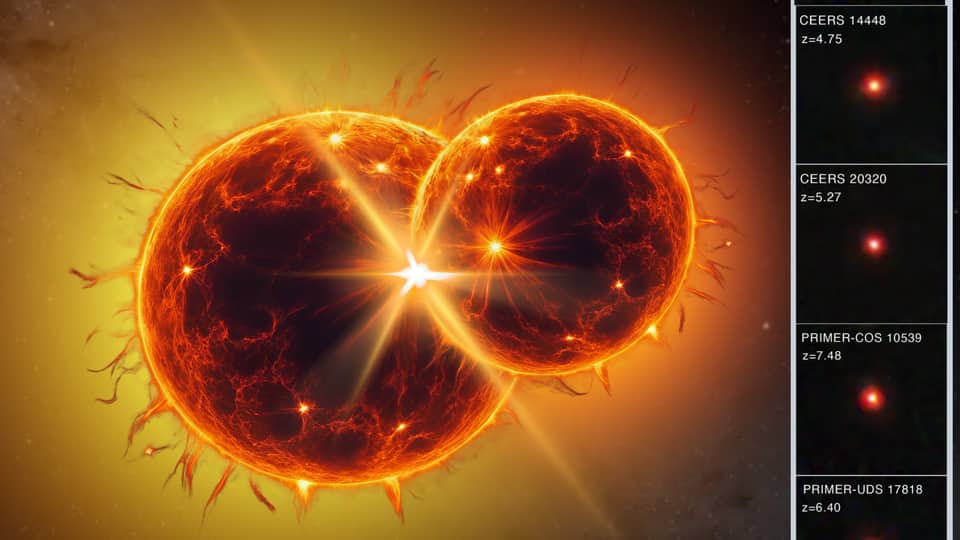
Early-Universe Star Collisions May Explain Little Red Dots
Simulations suggest dense early-universe star clusters could produce massive stars through repeated mergers, leaving black-hole seeds behind.
FlyMarshall Newsroom1 min read
Photo: Robert Lea
A research team used simulations to examine how stars behaved in dense clusters in the early universe. The models suggest that repeated, relatively slow stellar mergers could build a star with a mass comparable to its cluster, and that the star’s eventual collapse could create an intermediate-mass black hole.
Key details
- The study proposes that some compact, reddish objects known as Little Red Dots could be dense stellar clusters undergoing repeated collisions.
- The James Webb Space Telescope has observed Little Red Dots in the early universe, but their physical nature remains uncertain. One proposed explanation involves rapidly growing black holes.
- The proposed black-hole seeds could grow into supermassive black holes.
- The study appeared in The Astrophysical Journal on October 26, 2026.
In the model, a merged star could reach a mass comparable to that of its entire cluster.
Why it matters
The model offers a possible path from dense early star clusters to the seeds of supermassive black holes. It also links the proposed environment for Little Red Dots to a period when the universe was younger than about two billion years; cosmic expansion and cooling could have changed conditions in those environments.
More stories
NASA Seeks Industry Ideas for Hubble Space Telescope Servicing
Three U.S. Astronauts Vote in 2026 Midterms From the ISS
Astrobee Robots Support Research Aboard the International Space Station
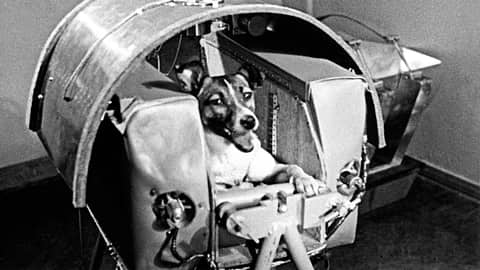
Sputnik 2 Launched With Laika Aboard on November 3, 1957

Sceye and SoftBank Sign Five-Year HAPS Services Agreement