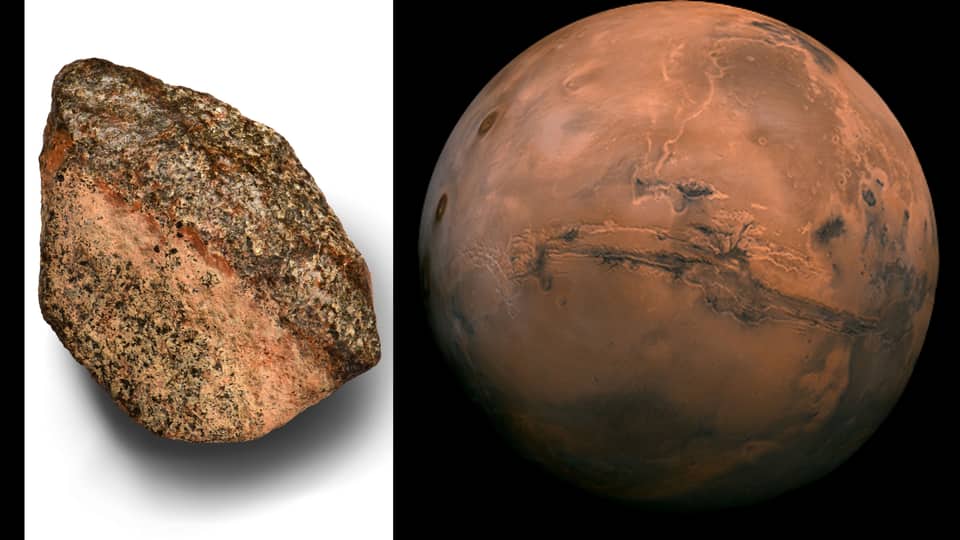
Ancient Martian Meteorite Teghaza 001 Offers Clues to Mars' Early Water
Researchers dated water alteration in the Mali-named meteorite to about 4.1 billion years ago and identified candidate locations for its origin on Mars.
FlyMarshall Newsroom1 min read
Photo: Darryl Pitt / Maine Mineral & Gem Museum
Researchers used mineral dating to examine Teghaza 001, a Martian meteorite named for a salt plain in Mali where it was reportedly found in 2022. Their analysis indicates that water altered the rock about 4.1 billion years ago.
Key details
- Teghaza 001 weighs about 800 grams.
- Researchers used oxygen-isotope analysis to identify it as Martian and rubidium-strontium dating of mineral grains to investigate its age.
- The team identified 13 possible Martian locations with mineralogy and chemistry that may match the meteorite; its exact origin remains unknown.
- The study was reported as published in Science on October 29, 2026.
- A separate study on the meteorite’s water content was reported as published in Science Advances on June 10; the year was not specified.
Researchers identified 13 possible Martian locations whose mineralogy and chemistry may match Teghaza 001.
Why it matters
Water altered the rock before it reached Earth, giving researchers evidence about ancient conditions on Mars. Matching the meteorite’s mineralogy and chemistry with candidate locations may help connect laboratory analysis of Martian rocks to specific regions of the planet.
More stories
Boeing's F/A-XX Win Remains Unconfirmed

Finnair Plans Flights to Five Finnish Cities From 2028

IAG Reports €1.7 Billion Third-Quarter Operating Profit

Singapore Airlines Plans S$2 Billion Long-Haul Cabin Redesign

LATAM CEO Sees Two More Years of Aircraft Delivery Disruption