
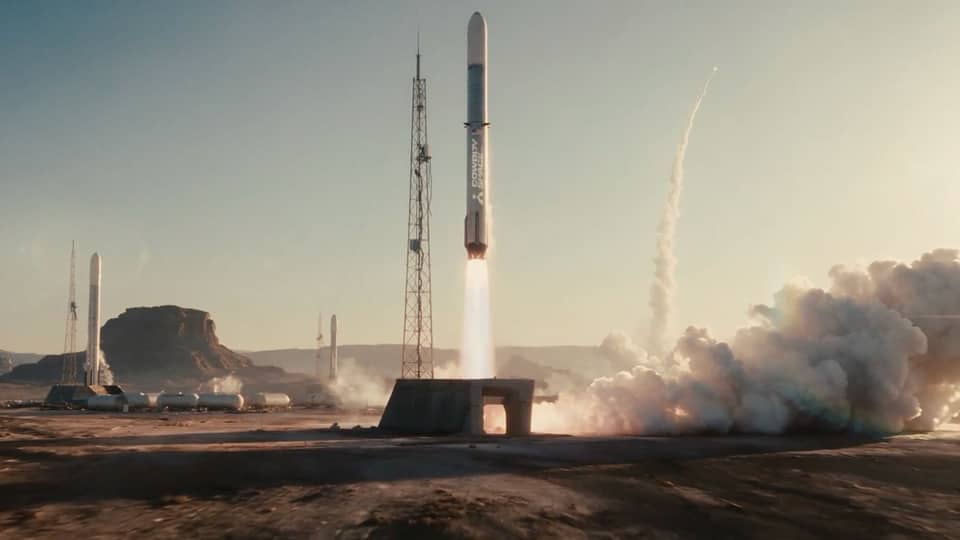
Cowboy Space Unveils Big Iron Rocket for Orbital Data Centers
Cowboy Space announced Big Iron at its Big Sky Rising event on October 26, outlining a reusable rocket concept tied to a proposed low-Earth-orbit computing network.
FlyMarshall Newsroom2 min read
Photo: Cowboy Space
Cowboy Space announced Big Iron, a planned two-stage rocket designed to carry data-center satellites into orbit. The company is targeting December 2028 for the rocket’s first flight, while describing that schedule as ambitious and not assured.
Key details
- The proposed rocket would use a reusable first stage, while its upper stage would remain in orbit as a data-center satellite.
- Cowboy Space plans to deploy a low-Earth-orbit constellation called Stampede, with a target of about 20,000 satellites and one satellite aboard each Big Iron launch.
- The proposed satellite would provide about one megawatt of computing capacity, use five GPU racks and weigh about 15,000 kilograms. Its unfolded solar panels would extend to about 132 meters.
- The company plans to offer launches to outside customers under the name Big Iron Express.
- Clydesdale engines would power the rocket: nine on the first stage and one on the upper stage, burning liquid oxygen and liquid methane.
- Cowboy Space leader Baiju Bhatt founded the company in 2024 as Aetherflux.
- The company’s Reason-1 satellite launched on SpaceX’s Transporter-18 rideshare mission on October 1 to test laser power transmission from orbit to Earth.
Cowboy Space’s proposed Stampede network targets about 20,000 low-Earth-orbit satellites.
Why it matters
Big Iron would combine a reusable launch vehicle with a proposed orbital computing network, while Big Iron Express would give outside customers a launch service tied to the same rocket. The plan connects launch capacity with the deployment of large computing satellites in low Earth orbit.
What happens next
Cowboy Space is aiming for a first Big Iron flight in December 2028 as it develops the rocket and Clydesdale engines. Which part of the plan will you be watching most closely: the reusable booster or the orbital data centers?
More stories

Gemini North Reveals Knots in Supernova Remnant Pa 30

November 2026 Beaver Moon Reaches Full Phase on November 24

Vault Comics Plans Dungeon Crawler Carl Series for January 2027
NASA's Perseverance Rover Logs 28.10 Miles on Mars
NASA's First Saturn Rocket, SA-1, Flew on October 27, 1961
